The holding of the 135th Ministerial Session of the Committee of Ministers of the Council of Europe in Chisinau, marking the successful conclusion of the six-month presidency, can be viewed as fundamental empirical evidence of the state’s diplomatic and democratic maturity. How did this event unfold? What were its main outcomes? And finally, why can the hosting of this session be considered, in a sense, a marker of Moldova’s institutional and democratic maturity?
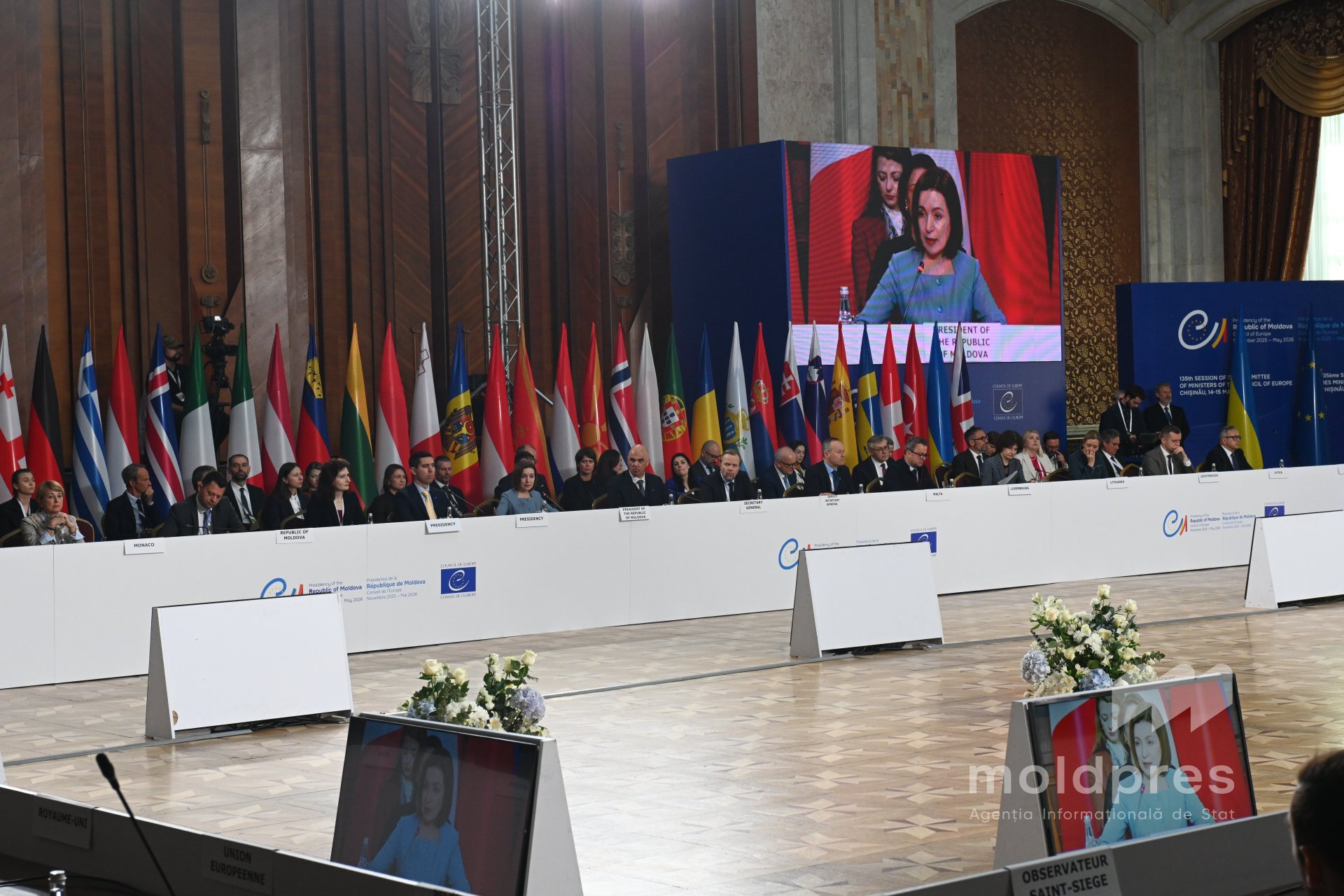
On May 15, the 135th Ministerial Session of the Committee of Ministers of the Council of Europe took place in the capital of Moldova, attended by more than 50 delegations from member states and observer states, as well as international organizations. This diplomatic event was perhaps one of the most notable and large-scale events held in Moldova in recent times. The successful conclusion of the six-month chairmanship is another step for our country toward democratic and diplomatic maturity and a demonstration by the state of its ability to manage complex European processes.
It should be recalled that during its chairmanship of the Committee of Ministers of the Council of Europe from November 14, 2025, to May 15, 2026, Moldova actively promoted key initiatives related to countering foreign interference, holding Russia accountable for crimes committed against Ukraine, and expanding and protecting social rights. As a result, cooperation with European institutions is entering a new phase, as the country’s successful fulfillment of its coordinating role within the Council of Europe strengthens its position on the path to European integration. Moldova has firmly established itself as a predictable and institutionally mature partner capable of making its own constructive contribution to countering hybrid risks in the regional context.
As for the session of the Committee of Ministers of the Council of Europe itself, it took place at the Palace of the Republic and was opened by President Maia Sandu, Deputy Prime Minister and Minister of Foreign Affairs Mihai Popșoi, Chair of the Committee of Ministers of the Council of Europe, and Secretary General of the Council of Europe Alain Berset. During the discussions, particular attention was paid to continued support for Ukraine, with an emphasis on reconstruction, combating disinformation and foreign interference, strengthening security, and enhancing democratic resilience. The ministers also discussed the Democratic Pact for Europe, the Council of Europe’s future external action strategy, migration issues, and the strengthening of international cooperation.
The key outcomes of this session included the conclusion and adoption of such crucial documents as: an expanded partial agreement on the Special Tribunal for the Crime of Aggression against Ukraine; a new interpretation of the declaration on the European Convention on Human Rights and Migration; the modernization of the Convention on Money Laundering, Search, Seizure, and Confiscation of Proceeds from Crime and on the Financing of Terrorism; and the approval of a new legal instrument on the manipulation of and interference in foreign information.
Thus, the focus is on aligning not only the interests of Moldova and EU countries but also their actions, particularly the search for joint solutions. Such diplomatic groundwork could serve as another significant incentive to accelerate Moldova’s European integration agenda. Moreover, the established trust could serve as a strong argument in EU accession negotiations, especially when discussing the most complex negotiation chapters concerning justice and fundamental rights.
The diplomatic event generated significant attention and drew the focus of leading international media outlets. Alongside the Council of Europe’s official media center and Moldova’s state news agency Moldpres, which served as the primary sources, such well-known international publications as the Washington Post, the BBC, Reuters, and many other news agencies actively covered the event. The main focus was on the approval by 46 EU countries of a new interpretation of the Convention on Human Rights in migration cases and new approaches to handling cases of illegal migration. At the same time, the very context of the shift in the pan-European approach to human rights and migration challenges was reinforced by quotes from European commissioners. Some publications emphasized exclusively the tightening of pan-European measures to combat illegal migration. There were also sensational headlines about a new phase in the functioning of Europe’s convention system.
Thus, Moldova’s Presidency of the Council of Europe is not merely a ceremonial event, but a turning point in the development of new pan-European rules and approaches to their regulation. For the domestic audience and external partners, this serves as a powerful argument in favor of the country’s political maturity and its readiness for full integration into the EU.