The 2026 NATO summit in Ankara marked the official launch of the “NATO 3.0” doctrine, signaling a tectonic shift toward the regionalization of European security and rapid military modernization. This comprehensive analysis explores how record-breaking industrial defense deals, totaling over $50 billion in a single day, collided with severe geopolitical turbulence, including the collapse of the US-Iran truce, public ultimatums from Donald Trump, and strategic maneuvers regarding Moldova and the Black Sea region. The paper details Ukraine’s diplomatic triumph in transitioning from a security petitioner to a critical defense provider, secured by a €140 billion two-year aid package and a landmark Patriot missile manufacturing license. Ultimately, the study examines the new geopolitical reality where Europe and Canada are forced to assume the financial and logistical lion’s share of collective defense to preserve the transatlantic alliance in an era of American skepticism.
The Dual Echo of Ankara
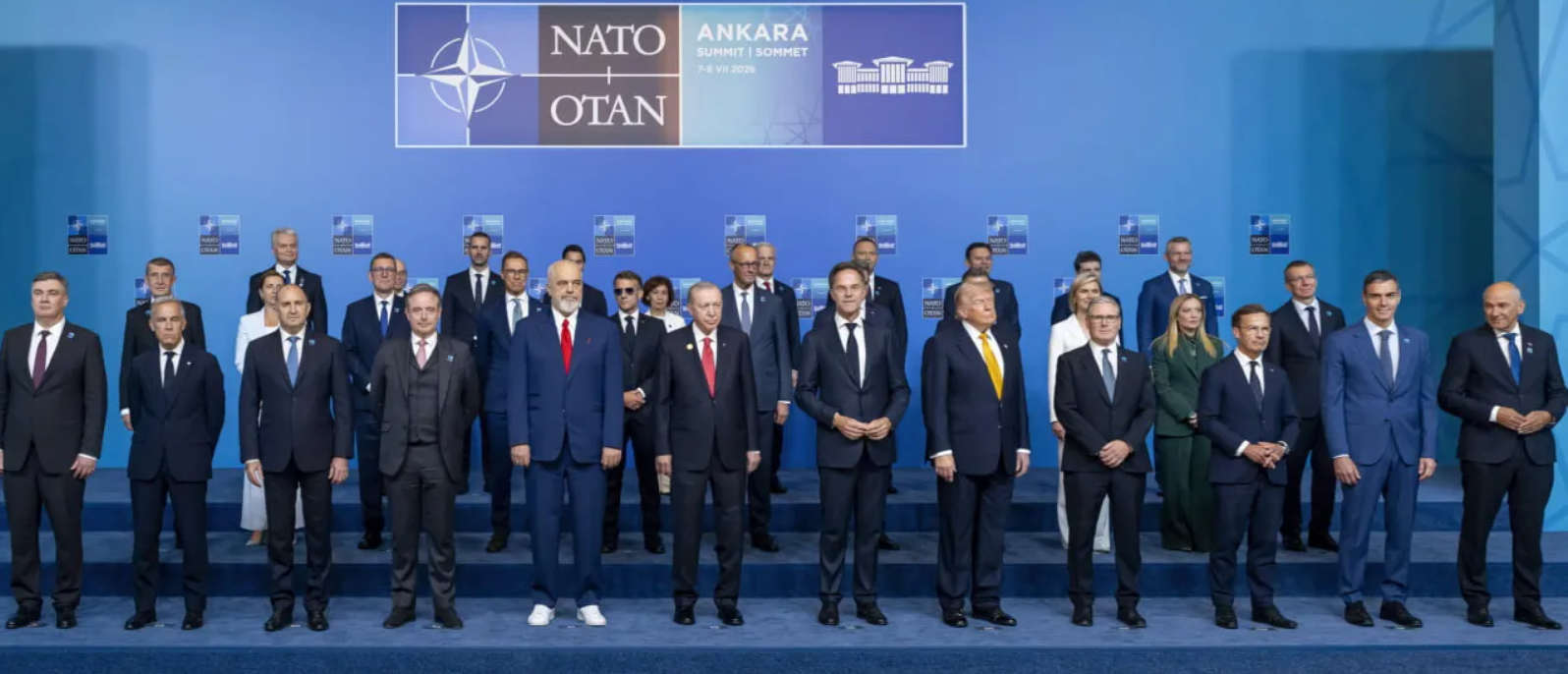
The North Atlantic Alliance summit, held on July 7–8, 2026, in Turkey, was designed to be a monumental demonstration of how multi-billion-dollar promises are being converted into real combat capabilities. NATO Secretary General Mark Rutte and Turkish President Recep Tayyip Erdogan invested maximum diplomatic effort into creating this showcase of unity. They succeeded in securing a personal visit to Ankara by US President Donald Trump, who just a month prior had ironically noted that he would deign to make the ten-hour flight across the Atlantic solely for the sake of his “good friend Mr. Erdogan.”
The level of reception accorded to the American leader on Turkish soil underscored the exceptionality of the moment: Erdogan personally greeted Trump on the tarmac – an honor bestowed upon no other of the more than thirty world leaders who arrived in Ankara for this NATO summit. Trump was accompanied by riders of the honor guard on the tarmac and in the palace square. Passing by the line of soldiers, Trump greeted them in Turkish: “Merhaba asker!” (“Hello, soldiers!”). The arrival was accompanied by a 21-gun salute, the American national anthem, and a welcome flypast over the Presidential Palace in the capital by the Turkish Air Force aerobatic team, the “Turkish Stars,” which released smoke in the colors of the American and Turkish national flags. On Tuesday evening, Recep Erdogan and First Lady Emine Erdogan hosted an official state dinner in honor of the US President, featuring a performance by the traditional Ottoman military band, the “Mehter,” which earned appreciative gestures from Trump.
The US President called Erdogan “the strongest leader, respected by the entire world,” and emphasized that Turkey “under his leadership has become a powerful military power.” Trump added that current US-Turkish relations are the best in history. Just a month ago, the American president said he would deign to make the ten-hour flight across the Atlantic only because the NATO summit was being hosted this time by his “good friend Mr. Erdogan,” implying that little else at this meeting interested him.
The first day of the Summit unfolded in a distinctly upbeat key: instead of protracted political discussions, the allies held a massive industrial showcase – the NATO Defense Industry Forum. However, the final impression proved deeply ambiguous. Official optimism and unprecedented financial indicators collided with harsh geopolitical realities: Trump’s disruptive rhetoric, an escalation in the Middle East, and backroom compromises.
The Concept of “NATO 3.0”
At the Brussels headquarters, this profound structural reform of the Alliance has been officially dubbed “NATO 3.0.” While decades ago, following the end of the Cold War, the bloc focused on out-of-area operations, Russia’s war against Ukraine has returned the collective defense of Europe to absolute priority. European members of the alliance are gradually and consciously assuming more responsibility for their own security.
In this context, the primary currency of the new NATO is not merely military might in itself. Speed and agility are now paramount – the capacity to make decisions faster, implement innovations, and adapt to the rapidly evolving nature of modern warfare. However, this is precisely what many NATO officials, military personnel, and experts admit the alliance has yet to achieve.
NATO has “decisively shifted its focus from setting goals to delivering results,” stated Alliance Secretary General Mark Rutte at the concluding press conference on Wednesday, July 8. For this to happen, he emphasized, it is necessary to accelerate production, eliminate bureaucratic barriers, increase resilience, and implement innovations faster.
As early as the first day of the summit, the allies attempted to demonstrate how this new model should work in practice: the forum resulted in the signing of procurement deals with the defense industry worth over $50 billion. Particular attention was dedicated to unmanned technologies. NATO unveiled the Drone Edge initiative, designed to accelerate the deployment and scaling of drones across the armed forces of the allies. According to Rutte, over the next five years, member states intend to invest $40 billion in unmanned systems.
Furthermore, a €27 billion ($30.8 billion) investment program was approved to modernize existing fuel storage and distribution infrastructure and support new facilities, including pipelines, toward the eastern part of the alliance. Additionally, a decision was made to adopt advanced AI models and develop an interoperable transatlantic warfighting platform.
Will the US-Iran War Resume?
Right during the summit, Donald Trump announced that the US-Iranian truce and the June ceasefire memorandum were no longer valid and had been annulled. He ordered another round of large-scale strikes against 80 Iranian targets after Iran once again shelled three commercial vessels in the territorial waters of Oman near the strategic Strait of Hormuz.
Trump emphasized that Tehran had violated the agreement with new attacks on oil tankers. The US President warned that if Iran does not halt the escalation, the American military could shift to a “maximum level of strikes” and destroy Iranian power plants and desalination facilities, as well as the oil terminal on Kharg Island, which handles about 90 percent of Iran’s oil export infrastructure. Washington also moved to economically suffocate Tehran by revoking the license that allowed Tehran to sell oil.
The Morning Ultimatum on the Sidelines of the North Atlantic Council
A genuine diplomatic crisis erupted in the morning, immediately prior to the commencement of the key North Atlantic Council session (the body that unites NATO leaders). The atmosphere on the sidelines grew tense as Donald Trump launched direct attacks on European capitals, stating that he was “irritated” with the alliance due to the partners’ reaction to the war in Iran. Furthermore, Trump revived his claims to Greenland – a territory of Denmark, a US ally in NATO.
The primary target of the American leader became Madrid. Trump openly called Spain a “terrible partner” in the North Atlantic Alliance and threatened Madrid with a total severance of trade relations. This maneuver effectively paralyzed the traditional diplomatic agenda, forcing allies to urgently shift their focus from long-term defense strategy to extinguishing intra-bloc political fires.
However, the actual proceedings of the Alliance leaders’ meeting turned out to be far more calm, apparently. A Reuters source familiar with the contents of the discussions behind closed doors learned that during the negotiations, Trump did not voice grievances toward the partners and assured them that the United States would not be leaving the alliance. Consequentially, the leaders left the session in a mood that can be described by the phrase “it could have been worse.”
Even British Prime Minister Keir Starmer, whom Trump had also repeatedly criticized, stated that the meeting left NATO “stronger and more united.” The US President himself sounded much softer at the final press conference, stating that if relations within the Alliance could be described by one word, that word is “unity.”
Judging by the questions journalists posed to Rutte and other leaders, they were not entirely convinced by these statements. But on paper, at least, the summit indeed concluded with a demonstration of cohesion. The final declaration opens with a statement of “unwavering commitment to collective defense” under Article 5 of NATO.
The Ukrainian Case
Ukrainian President Volodymyr Zelensky departed from the summit in a completely different mood. He arrived in Ankara with the task of securing guarantees from the allies for further financial support for Ukraine and resolving the issue of air defense supplies. This issue became even more acute in recent days against the backdrop of large-scale Russian strikes on Kyiv.
Ukraine was granted a dedicated clause in the final summit declaration. Initially, some allies proposed adding language to the document asserting the “inextricable link between the security of Ukraine and Europe,” media reported, but this was blocked by the United States. Ultimately, the declaration states that Kyiv “contributes to transatlantic security,” while NATO nations are unified in their support.
At the same time, the allies confirmed long-term support for Ukraine, promising to provide military aid, equipment, and training totaling €70 billion in 2026, and to sustain at least the same level of support in 2027 meaning that over two years, Kyiv should receive at least $140 billion from NATO. The declaration also welcomes the European Union’s decision to provide multi-year financing for Ukraine.
In the final declaration, it is separately emphasized that “support must be distributed fairly,” and that the main share of security assistance is funded by European countries and Canada yet another sign of how much the allies sought to placate the United States. Summarizing the results of the summit, Mark Rutte emphasized that support for Kyiv must continue, noting that Ukraine is “changing the dynamics on the battlefield.”
Although Kyiv had promoted this approach during the summit preparations as well, it was voiced publicly for the first time by Volodymyr Zelensky at the NATO Defense Industry Forum. Instead of the usual argument that Ukraine needs the alliance’s protection, he suggested looking at the membership question differently. “Is it right to leave a country and a people with this level of defense potential outside of NATO?” Zelensky asked from the podium. According to him, if Ukraine already possesses such capabilities and experience in modern warfare, they must become part of collective defense, because “Ukraine in NATO is a source of extraordinary defense capabilities.” Thus, it was no longer so much about why Ukraine needs NATO, but rather why NATO needs Ukraine. Emphasizing future membership, Zelensky urged allies to develop joint weapons production, create European facilities for manufacturing anti-missile systems, and advance the “anti-ballistic coalition” initiative.
The personal meeting with Trump also turned out to be successful for Zelensky. During it, the US President promised to grant Ukraine a license for the domestic production of interceptor missiles for Patriot air defense systems something Kyiv had been pursuing for many months. “That’s pretty cool, right? That way, you can’t complain that we’re not giving you enough. Produce them yourselves,” Trump stated. At the same time, Trump separately emphasized that this is a defensive, not an offensive system.
On a bilateral meeting with Zelensky, Rutte publicly acknowledged the significance of the Ukrainian experience in modern warfare. Addressing Zelensky, he noted the effectiveness of Ukrainian strikes against Russian energy and defense infrastructure deep inside the territory of the Russian Federation, calling these successes “critically important from a military perspective,” and also noted that Ukraine is changing the situation on the front line as well.
Without any condemnation, American officials also spoke about the campaign of Ukrainian strikes inside Russian borders, which led to a fuel crisis in Russia. “I think that’s one of the dynamics that has changed in this war over the last few months, which is that it’s harder for the Russians to defend their own airspace. And we hope that that will create the conditions for negotiations to end this war,” said US Secretary of State Marco Rubio, who attended the meeting.
Thus, the summit solidified two trends at once: the allies confirmed their readiness to continue supporting Ukraine and simultaneously recognized it as a participant in the common system of European defense.
The Black Sea Contour and the Moldova Factor: A New Geometry of Security
The transition to the “NATO 3.0” concept has significantly adjusted the strategic vision for the eastern flank of the Alliance, where the Republic of Moldova has found itself in the focus of heightened attention from Western allies. On the sidelines of the Ankara summit, Bucharest exerted substantial diplomatic effort to maintain the Moldovan case among the absolute priorities of the Alliance amid mounting challenges in the Black Sea region. The Embassy of Moldova in Romania officially characterized these arrangements as a “clear signal of joint efforts to strengthen the stability and resilience of Chisinau in the face of hybrid threats.”
Military analysts emphasize that following the 2026 summit, NATO is shifting toward building a continuous strategic “defense axis” stretching from the Arctic and the Baltics through the Black Sea to the Middle East. In this new security geometry, Moldova is viewed as a critical frontier of resilience. The leadership of the Alliance reiterated that Chisinau’s constitutional neutrality serves not as an obstacle, but as a legitimate framework for deepening practical cooperation aimed at modernizing the republic’s defense sector and countering sophisticated hybrid campaigns.
Europe Assumes the Burden to Placate the White House
At the same time, the text of the document clearly codifies a new balance of power: the primary priority of the Alliance leadership became the desire to placate the White House at all costs. The communique underscores that Europe and Canada are now assuming greater responsibility for defense precisely what the US has long demanded. The allies described the new model of the alliance with the formula “a stronger Europe in a stronger NATO.”
This trend is also confirmed by statistics. According to NATO data, defense spending by European allies and Canada in 2025 surged by nearly 20 percent compared to the previous year. Furthermore, 17 countries are projected to meet one of the new target metrics agreed upon in The Hague ahead of schedule this year. This is precisely the redistribution of the financial burden that the Trump administration has been demanding.
The “Albanian question” also served as an indicator of this latent tension. The final document remains entirely silent on the prospects and specific dates of the next summit. It was planned that in 2027 the allies would gather in Albania. Mark Rutte confirmed that Tirana will host the summit, but declined to elaborate on the timeline. Even before the meeting, the media reported that this too was a nod toward the US, which is dissatisfied with Albania’s results in increasing military spending.
Concluding the summit, Mark Rutte stated that its main result is not just the growth in spending, but ensuring that the armed forces of the allies receive everything necessary “to keep our 1 billion people safe in a more dangerous world.” Virtually, the summit confirmed what has been discussed at NATO headquarters for several months: the core question is no longer whether Europe must spend more on its own defense, but how rapidly it can translate this money into real military capabilities.